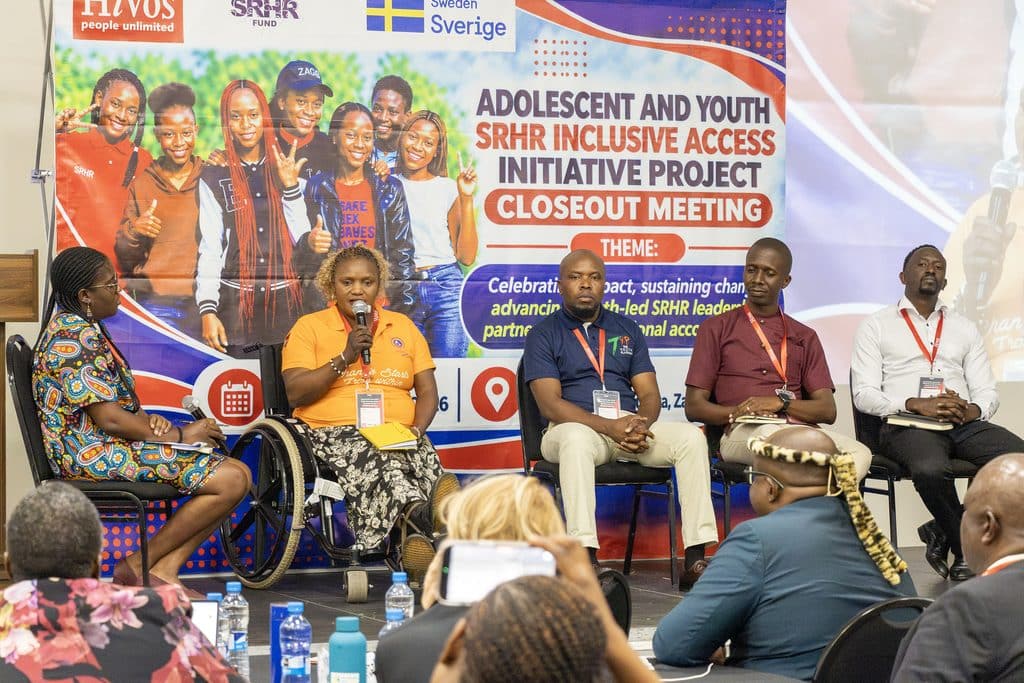
The Regional Sexual and Reproductive Health and Rights (SRHR) Fund is a regional fund strengthening SRHR work across Southern and Eastern Africa since 2007. Hivos’ Head of Programs, Tanja Lubbers, attended the event marking the close of Sida’s contribution to the Fund. She finds it difficult to call it a “closure”, because much of what has been built will continue long after the program ends.
By Tanja Lubbers, Head of Programs
The Regional SRHR fund has been supported by The Ford Foundation and the Dutch government since 2007. In 2017, Sida joined as a funding partner. When we signed our first grant agreement with Sida, we decided to focus on the sexual and reproductive health and rights of young people and adolescents. At the time, we had strong ambitions, but none of us could fully know where that first signature would lead, or how many people, organizations and movements would make the Fund their own.
Nearly a decade later, Sida’s funding cycle has come to an end. When I look back on those years, it is not the agreements signed or the reports produced that stay with me. What stays with me is hearing young people find their voices, claim their rights and become leaders in their communities.
I’m proud to have seen small organizations grow in confidence and influence. It has been a privilege to see activists and partners create spaces where young people can talk openly about sexuality, health, rights and choice, often in environments where doing so requires enormous courage.
Finding purpose
The SRHR Fund established a Youth Advisory Panel (YAP) to put young people not at the receiving end of decision making, but at the center. YAP members have represented young people’s voices in regional policy spaces and contributed to strategic decisions, grant-making processes, and advocacy efforts.
The story of YAP member Faith Mairah particularly stayed with me. During the close-out, she shared that when she joined the panel, she was going through a very difficult period in her life. Being part of the YAP helped her rediscover a sense of purpose and gave her a space to learn and grow. When Hivos first approached her, she remembers thinking: perhaps one day I could work for Hivos.
Today, as the CEO of Ingo Female Transporters Ltd, she creates jobs for other people. I find that story incredibly moving.
We sometimes speak too easily about empowering young people, as though power is something an organization like Hivos can bestow on someone. Faith’s story suggests something different. Our role is to create space, open doors, put our trust in people and, sometimes, simply step aside.
Moving beyond initial funding
During the close-out, partners reflected on how they had grown through the Fund. The story from WAG Disability Rights particularly stood out to me. Its Executive Director, Stella Nkhonya, who recently became a Human Rights Commissioner in Malawi, reflected on how the organization had evolved throughout its partnership with Hivos.
Stella told us that the Hivos’ capacity strengthening helped her organization develop stronger systems and structures. Today, nine different donors trust those systems and fund Stella’s work.
An important lesson we can learn from the SRHR Fund is that stronger organizations increase donor confidence and are better positioned to attract further funding. We often measure a grant by what happens while it is being implemented. How many people did we reach? What changed? Did we achieve what we promised?
Yet an equally important question is: what became possible afterwards? If organizations emerge stronger, more confident and able to attract other funders, then the original investment reaches far beyond the duration of the grant itself.
Helping shape independent organizations with institutional strength to grow beyond our funding is what true sustainability looks like.
A bittersweet goodbye
Funding has a beginning and an end, but social change does not follow a timeline.
The inequalities and restrictions that made this work necessary have not disappeared. Young people still need access to information and quality sexual and reproductive health services. LGBTIQ+ people and other marginalized communities continue to face discrimination and exclusion. And those defending these rights are doing so in increasingly contested political and civic spaces.
So, while we should celebrate what has been achieved, we should not pretend that the work is finished. Looking back to that first agreement I signed in 2017, I feel incredibly proud of what grew from it. Not because everything went according to plan. Social change rarely does. But because so many people took the opportunity that this Fund created and turned it into something far greater than any program document could ever have described.
To Sida and everyone who believed in this work: thank you for making that journey possible. Especially to the young people, activists, organizations and partners who carried it: thank you for your courage, creativity and persistence.
Today we may close a project, but the people, organizations and movements it supported are not closing. They will continue moving forward, and that is perhaps the Fund’s most important legacy of all.