The LGBTIQ+ movement stands at the frontlines of the struggle for equality and justice. But as aid budgets are shrinking, they are often among the first to lose out. At WorldPride 2026, Chandreyi Guharay spoke with queer activists from around the world about how they’re navigating this new reality.
By Chandreyi Guharay, Global Advocacy Officer, Walking the Talk
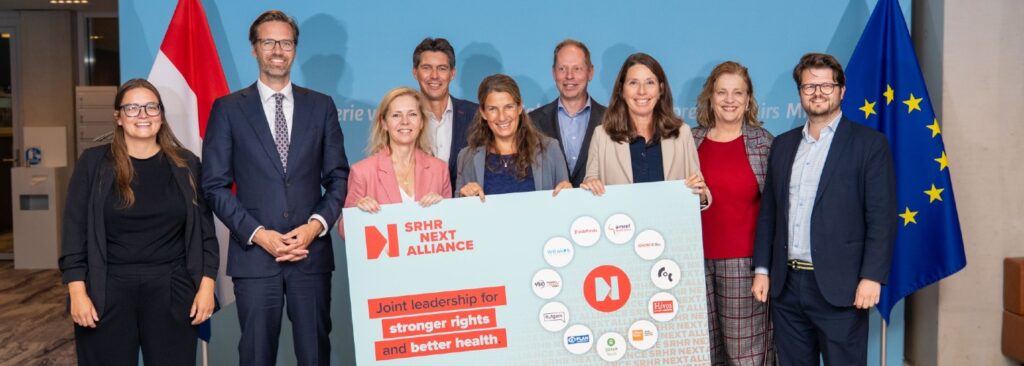
Queer activists and Dutch NGOs gathered at Amsterdam City Hall as part of “Building Bridges”, a WorldPride 2026 visitor program for LGBTIQ+ community leaders run by the Dutch Ministry of Foreign Affairs and COC Netherlands.
Pride is every day, everywhere
Although we were in Amsterdam, the work back home never stops for activists. Enkhmaa Enkhbold, Executive Director of the LGBT Centre in Mongolia, excused themself a couple of times to check their phone. “We’re organizing Pride in Mongolia, and it’s happening in two weeks,” they explained. Among many other things, their organization drives policy advocacy and movement building for LGBTIQ+ rights and helps queer people facing persecution find a safe way out.
John Mathenge Mukaburu is also doing the daily work of resistance. His organization HOYMAS in Kenya runs clinics across three counties, serving almost 20,000 patients from key populations, including gay and bisexual men and sex workers. In Nigeria, Cosmas Osinachi Ihenacho-Herbert, Program Director at Obodo, shared how they are changing the narrative by elevating the leading role queer people play in shaping art and culture across the country and the African continent.
And in Vietnam, Nguyễn Diệu Anh co-founded Yêu-nữ (Women Living Wicked), a sapphic collective that hosts regular gatherings where women have a place to find joy and each other. Whether it’s healthcare, protection, culture or belonging, these efforts keep communities alive. Still, they have never been properly funded.
Less funding, more backlash
As an advocate for gender equality and a queer activist myself, I know how much LGBTIQ+ movements do with so little. Even before the dismantling of USAID and the funding cuts across other major donor countries, just 4 cents of every $100 in Official Development Assistance (ODA) went to queer communities. Now even that is rapidly disappearing. And what little there is doesn’t land evenly. As trans activist Marcela Morales from Asociación Lambda in Guatemala emphasized: “Most of the funding goes to gay men’s and trans women’s organizations. Very little reaches organizations of trans men and LBQ women.”
But this isn’t just about money. The same politics driving these cuts are shrinking civic space everywhere. Anti-rights actors are growing richer and bolder, finding new ways to target LGBTIQ+ people, as my colleague Jordan Dittmar has written. Queer and feminist activists defend the right to protest, to speak and love freely, to put care for people and the planet at the center and to decide over our own bodies and lives. And yet our rights are always the easiest target, and our funding the first to be cut. We are the canary in the coal mine, and everyone else’s freedoms are never far behind. That should worry all of us.
A lifeline built on solidarity
Bessy Ferrera was a trans activist from Honduras who fought for the rights of trans people, sex workers and people living with HIV, and whose life was violently cut short in 2019. A year later, Hivos established the Bessy Ferrera Emergency Fund in her name. It offers fast, practical help to LGBTIQ+ activists facing threats because of their work, from medical and legal costs to security and relocation. Since 2022, it has helped nearly 100 people and organizations around the world.
When I mentioned the fund to Ribal Maatouk, National Chairperson of the LGBTIQ+ Task Force in Lebanon, he told me he already knew it well. Through Israel’s devastating invasion and war, the Task Force, alongside its member organizations, notably specialized local LGBTIQ+ CSOs, have continued to provide humanitarian support to queer people. “From all the funding initiatives, the Bessy Ferrera Fund was the most easily accessible for our community, allowing for a faster deployment of emergency support than other organizations,” he said. “I need to give credit where it’s due.”
Hope for the long haul
Emergency funds provide a vital lifeline during a crisis, but activists and their movements also need lasting support. For Cosmas, the lesson is hopeful: governments change with elections, and funding changes with them, but movements can outlast both. For activists in the Global South, that has often been the reality. “Maybe the question is not how we survive this crisis,” he said, “but how we build a movement infrastructure that’s strong enough for us to thrive through whatever comes next.”
He also sees an opening: with the US stepping back, the Netherlands could once again be the champion of gender equality and LGBTIQ+ rights it used to be. With a new Dutch government in place, there are signs of greater political will, and now is the moment to turn it into funding.
What comes after the parade
The activists I met have been holding their communities together, standing alongside feminist and queer movements everywhere to defend rights and freedoms for all. As we often say in the gender equality movement, imagine what they could do with the right support. Solidarity beyond the parade means that governments, funders and allies invest in queer aspirations.
This opinion piece was first published on the Washington Blade.