
Water farming: the power of resilience and smart agriculture
The story of Eugine Mubika from Kitwe, Zambia
For Eugine Mubika, education is not only a right but also a tool for community action. His commitment is clear: to interweave networks of innovation so that young people are not seen as passive spectators yet recognized as protagonists of change.
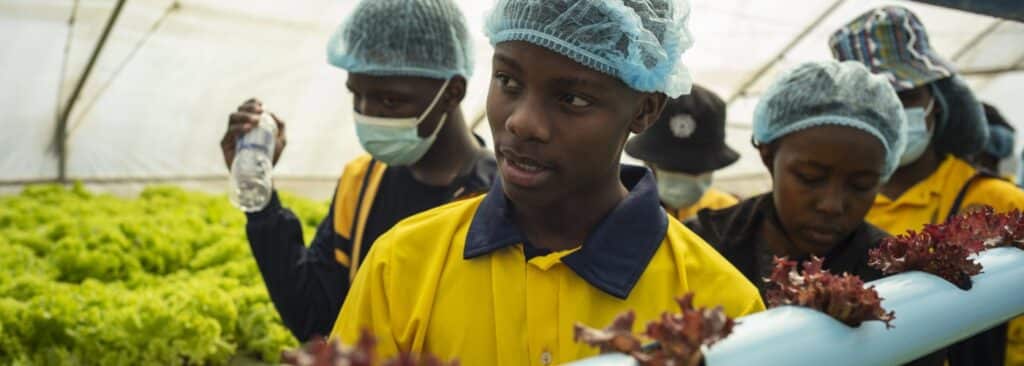
As CEO of Cosma Agro Solutions, he promotes a model of smart agriculture that responds to the challenges of climate change. The process ranges from advising families and communities on identifying spaces where simple hydroponic systems can be installed —gardens, backyards, or homes— to developing prototypes and supporting their implementation.
“What inspires us is being there for our community, producing what it needs most to ensure its food sovereignty.”
The project focuses on young people. It trains them in permaculture, connects them with local markets and universities such as Copperbelt and Mukuba, and opens up a different horizon for them beyond mining, the region’s common productive activity. It is not just about growing vegetables and local foods; rather, it is about building healthy food systems and generating real economic opportunities for the community.
Mubika challenges the traditional view of agriculture as hard work reserved for older generations. For him, agriculture is strategic, technological, and sustainable, without losing its ancestral roots. In this sense, hydroponics not only preserves nutrients and protects the environment, but also creates a space for innovation with an immediate impact on people’s lives.
This approach is reflected in Cosma’s team: young people trained in agronomy, plant nutrition, environmental engineering, agribusiness, and automation, brought together around a common purpose. They are proof that, with knowledge and commitment, young people can offer local solutions to global challenges.
Far from seeing agriculture as a relic of the past, Cosma envisions it as the path to a sustainable future. Its proposal goes beyond producing food: it seeks to raise awareness, strengthen community resilience, and sow new mindsets that make another tomorrow possible.
This project embodies the essence of the Urban Futures Program: promoting resilient food systems, empowering youth, and encouraging healthy and sustainable consumption. It is a testament to a way of life—organized, regenerative, flexible, and diverse—that replaces the logic of extracting and depleting with that of contributing, regenerating, and growing as a community.