We Lead, We Measure, We Transform
December 9, 2025
Feminist approaches to data, impact, and collective sense-making
Traditional data generation processes often privilege those with technical tools and expertise, creating barriers to meaningful participation in data collection, analysis, and interpretation. While this exclusionary dynamic persists in many spaces, We Lead’s feminist Design, Monitoring, Evaluation, and Learning (DMEL) framework actively reimagines these processes as political and inclusive; centering safety, horizontality, and co-creation to ensure that all voices, especially those of rightsholders, are valued and heard. By centering Communities of Action (COA)* in every stage of our work, we challenge power imbalances and democratize knowledge production.
By: Mary Kuira and Rebeca Chavarria-Solano from the We Lead team
As the cornerstone of We Lead’s DMEL model, we conducted Outcome Harvesting exercises at local, national, and global levels to identify and analyze the results of our advocacy efforts, capturing changes influenced by the sustained and dedicated work of COAs across nine countries: Niger, Nigeria, Uganda, Kenya, Mozambique, Lebanon, Jordan, Guatemala, and Honduras. Together, these three regions advance meaningful progress toward sexual and reproductive health and rights (SRHR) for young women: living with HIV, women with disabilities, those affected by displacement, and sexually diverse.
In the program’s closing phase, We Lead created its first Outcome Harvesting dashboard, complemented by a second interactive tool: the We Lead Interactive Global Impact Map, expanding feminist MEL to include transnational connections, mobility pathways, and cross-country advocacy dynamics. Together, these tools form a cohesive ecosystem for feminist, participatory knowledge production.
From harvesting to collective visualization: Co-creating feminist data tools
The Outcome Harvesting process typically begins with COAs convening in reflection forums, where they collaboratively harvest outcomes using a structured template designed to surface meaningful shifts in agenda setting, policy, practice, norms, and discourse. Through a participatory process involving country DMEL Focal Points across the nine countries, We Lead collaboratively systematized Outcome Harvesting data into an interactive analytics dashboard.
This dynamic tool visualizes geo-referenced outcomes (disaggregated by country, region, and national-level impact) and tracks patterns over time. It highlights trends in outcome collection, the diversity of engaged actors, and the presence of confidential outcomes that require enhanced protection and safeguarding in specific locations that can be related to their contexts. By enabling multi-dimensional analysis —such as filtering by country, year, or intermediate outcome— the dashboard transforms raw data into actionable insights, grounding feminist MEL in tangible evidence while safeguarding sensitive narratives.
Alongside the dashboard, we co-created the We Lead Interactive Global Impact Map, a Umap-based tool documenting international events, partnerships, and cross-country collaborations. While the dashboard visualizes outcome-level shifts, the map traces the wider ecosystem of movement-building and the circulation of feminist advocacy across borders. Together, they reflect not only what changed, but how transnational solidarities made that change possible.
Interactive filters, participatory data entry, and collective validation processes anchor both tools in feminist principles—shifting power from extractive reporting toward community-led visualizations and shared interpretation.
Exploring and making meaning through the tools
Both the Outcome Harvesting Dashboard and the Global Impact Map were designed as interactive, feminist MEL tools that invite users to explore, question, and make meaning from We Lead’s collective work. Rather than offering a fixed analytical path, they open space for critical inquiry —encouraging users to look at patterns, gaps, and the dynamics of power that shape advocacy.
The dashboard and the global impact map form a dual visualisation ecosystem that anchors feminist MEL in both evidence and memory
The dashboard helps users analyze what changed through visualizations of geo-referenced outcomes, actor engagement, confidentiality patterns, and trends over time. The map complements this by showing how change travelled, highlighting transnational connections, movement-building, international events, cross-country collaborations, and spaces where rightsholders’ voices gained regional or global visibility.
Both tools were co-created with DMEL focal points, POs, CoAs and rightsholders, making them collective memory artifacts as much as analytical instruments.
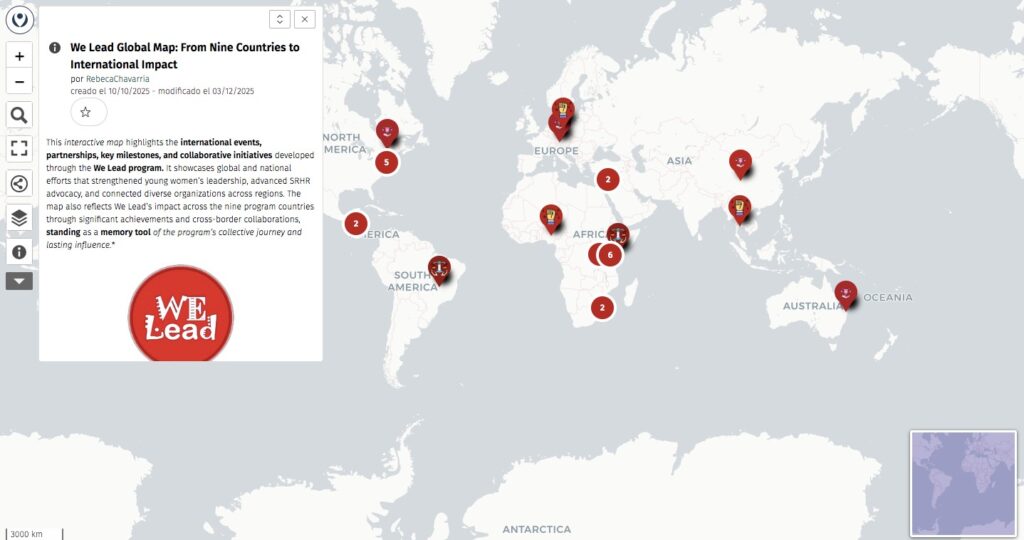
The Global Impact Map shows how change travelled, highlighting transnational connections, movement-building, international events, cross-country collaborations, and spaces where rightsholders’ voices gained regional or global visibility.
Users are encouraged to approach both the dashboard and the global impact map with a sense of inquiry—following the threads that emerge as they explore where change is concentrated, where it is missing, and what these patterns reveal about power, access, and context. As you move through countries, actors, and timelines, you might ask: Whose voices appear clearly here, and whose remain at the margins? What social, political, or economic conditions shape these patterns of visibility?
The tools also invite reflections on movement and strategy: How do advocacy efforts travel across borders? What alliances or opportunities helped amplify national work internationally? Where do we see heightened confidentiality or sudden shifts in activity, and what might these moments tell us about risk, repression, or urgent political windows? Taken together, these questions open pathways for deeper feminist sense-making, encouraging users not just to read the data, but to interpret, challenge, and build upon it.
These questions are not exhaustive—they are an invitation to use the tools as spaces for inquiry, learning, and continued collective analysis. As We Lead’s close-out phase unfolds, the dashboard and map remain open for exploration, encouraging users to revisit, reinterpret, and build upon the program’s feminist MEL legacy.
The dashboard and the global impact map form a dual visualisation ecosystem that anchors feminist MEL in both evidence and memory. One documents change; the other documents the movements, solidarities, and cross-border pathways that made this change possible. Together, they challenge extractive models of data use and instead position data as a space of learning, belonging, and collective sense-making.
A call for collaboration
As we reflect on the insights generated through these tools, we issue a dual call: first, for continued collaboration and innovation in monitoring and evaluation practices, and second, for sustained investment in decolonial data ecosystems that center grassroots knowledge.
We particularly acknowledge the foundational work of our DMEL Focal Points, whose expertise and contextual knowledge made this co-creation process possible. Their leadership in local data collection, validation, and analysis represents the feminist MEL principles we advocate for.
This dashboard and map are not endpoints, but invitations—to interrogate assumptions, to share ownership of knowledge, and to reimagine what counts as “evidence”. We welcome researchers, activists, and funders to join us in this ongoing practice of accountability through data justice, where every number, every coordinate, and every milestone tells a story of resilience, agency, and transformation.
* The Community of Action (CoA) is a facilitated safe space where young women and their organizations come together to share advocacy plans, priorities, and lessons learned, and to strategize around potential advocacy areas and synergies.