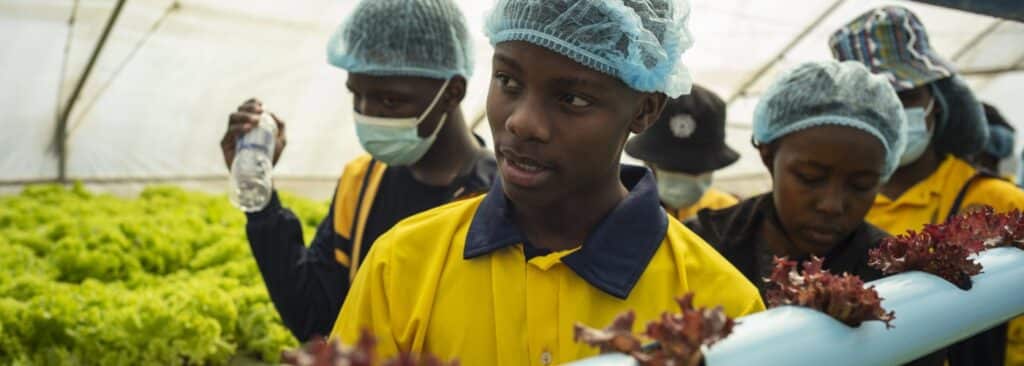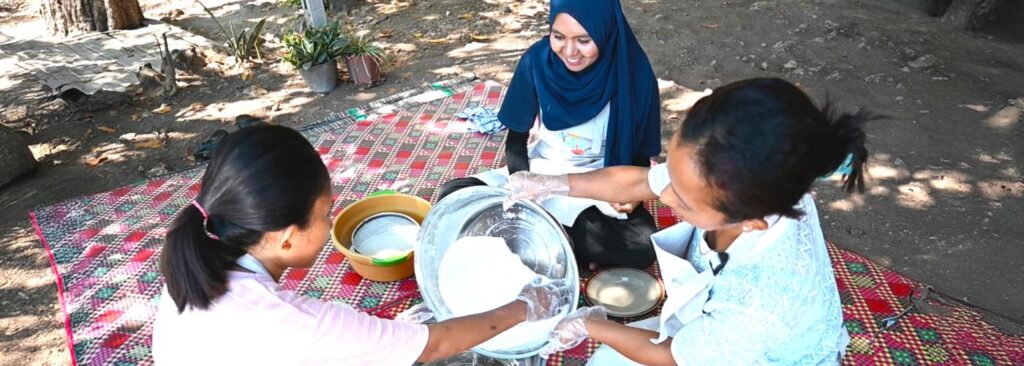
In an increasingly bleak funding landscape, taking the time to personally exchange experiences, listen to different perspectives, and build on what others have already tested is a worthwhile and necessary investment. It is a strategic opportunity. And this was the goal of the Urban Futures Annual Meeting, held from April 8 to 10, 2026 in The Hague.
By Mónica Tobar, Monitoring, Evaluation and Knowledge Management Officer, and Diego Orellana, Global Program Manager, Urban Futures
Representatives from Fondation Botnar, the global team, regional teams from Hivos and Humanis, and implementing partners from Colombia, Ecuador, Indonesia, Zambia, and Zimbabwe gathered not only to review program progress, but particularly to create space for listening, reflection, and shared learning.
Connecting teams is not an “extra” in the program. It is a deliberate choice. Because an idea that worked in Indonesia might inspire adaptation in Latin America, or a challenge in Africa could find a response in another region. This process moves the program beyond a loose collection of local initiatives to a unified global network that generates evidence to strengthen more resilient and sustainable food systems.
Taking time to learn from Urban Futures
Learning depends on your ability to pause, question what you are doing, and adjust your strategies. Thus, for three days, we held honest conversations about what has worked and what has not. After that, a single question remained. How could we make the most of the remaining 18 months of implementation to consolidate changes that will last?
As voices from Latin America, Southern Africa, and Indonesia brought the complexity of their contexts into the conversation, a common thread emerged. Contexts differ, yet many of the challenges are the same.
In several places, multi-stakeholder platforms have opened spaces for young people and women to play a real part in decision-making. At the same time, the next step requires stronger recognition and institutionalization of their role, so they can have greater influence on food system policies at local, national, and regional levels.
We also saw that change does not happen only through formal structures. The stories we tell, the language we use, and the ways we connect with communities shape how people understand and want to change food systems. So, people’s behavior is now at the core of how the program aims to bring about systemic change.
Across regions, the program’s capacity to strengthen support for partners is already showing concrete results, especially in how communities adopt more sustainable food practices. Still, sustaining these changes in unstable contexts remains a challenge and calls for more consistent support and strategies that go beyond short-term interventions. Without access to markets, for example, many of these efforts struggle to last.
Sustaining change beyond the moment
The meeting also pushed us to look ahead. We discussed which processes and partnerships can endure, and what conditions we need to grow stronger, so progress lasts beyond current funding. Our time together also reinforced a shared conviction across the program. Supporting young people and women in their enterprises does more than generate income. It strengthens their autonomy and resilience and helps change take root. When policies and programs place young people and women at the center, they open real pathways toward more just, resilient, and sustainable societies.
Hivos and Humanis deeply appreciate the participation of implementing partners in Cali, Medellín, Chocó Andino, MANPANOR, Chongwe, Kitwe, Bulawayo, Mutare, Bandung, and West Manggarai for their openness and generosity in creating a space rich in learning, exchange, and collective celebration. We extend our sincere thanks to Aimee Maron and Jessica Meker for their support in facilitating this gathering. Finally, we thank Fondation Botnar for its invaluable support and renew our commitment to continue building, together, food systems that place young people and women at the center.